
Introduction
For anyone preparing for surgery, one concern usually stands above the rest: how quickly life can return to normal afterwards. A shorter recovery, less discomfort, and minimal scarring can make a difference to patients and their families. Surgical technology has advanced considerably in recent years, and Ahmedabad now has access to advanced systems used in modern surgery.
Motherhood Hospital, Ahmedabad has installed the Karl Storz Image 1 S Rubina 4K 3D laparoscopy system with NIR/ICG fluorescence imaging. This technology provides enhanced visualisation during surgery and may help surgeons assess anatomical structures during selected procedures. Recovery and surgical outcomes depend on the procedure and each patient’s individual circumstances.
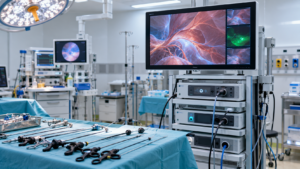
What Is 4K 3D Laparoscopy? Understanding the Technology
Laparoscopy, often described as keyhole surgery, is a minimally invasive surgery technique. Rather than making one large incision, the surgeon makes a few very small openings and inserts a thin instrument fitted with a camera. The procedure is performed through these small entry points, which can reduce trauma to the body compared with open surgery in suitable cases.
4K 3D laparoscopy combines three capabilities:
- 4K ultra-high-definition imaging: A picture with approximately four times the resolution of standard high definition, allowing surgeons to view anatomical details more clearly.
- Three-dimensional depth perception: Instead of a flat image, surgeons view the surgical area in 3D, providing depth perception during the procedure.
- ICG fluorescence imaging: A light-based technology that can help surgeons visualise blood flow and selected tissues that may be difficult to distinguish under conventional lighting.
At Motherhood Hospital, this laparoscopic surgery platform is available on Science City Road in Ahmedabad.
4K 3D vs. Traditional 2D Laparoscopy: Why Visualisation Matters
Conventional laparoscopy systems display a flat, two-dimensional image. While this format is used in laparoscopic procedures, the surgeon must interpret depth and distance from a flat screen.
4K 3D laparoscopy provides a detailed, three-dimensional view. Enhanced visualisation may assist surgeons during selected procedures:
- Surgeons can assess depth and distance during surgical movements.
- Delicate structures such as nerves and blood vessels may be easier to distinguish on the display.
- The visual information may assist with the placement of incisions and sutures.
Enhanced visualisation provides additional information to the surgeon during a procedure. Surgical technique, patient factors and the nature of the operation also influence recovery.
How 4K 3D Laparoscopy Relates to Recovery
The relationship between surgical imaging and recovery depends on several factors, including the type of procedure, the patient’s health and the surgeon’s clinical approach.
Enhanced visualisation → additional anatomical detail → support for surgical decision-making.
When a surgeon works with high-resolution imaging and three-dimensional depth perception, the system provides detailed views of the surgical area. The extent of tissue handling, blood loss, post-operative discomfort and recovery time varies according to the procedure and individual circumstances.
The recovery process depends on the type of surgery performed, the patient’s health and the post-operative care recommended by the treating team. This is one of the approaches used in laparoscopic surgery in Ahmedabad.
Key Recovery Considerations for 4K 3D Laparoscopic Surgery
Compared with traditional open surgery, laparoscopic surgery may offer benefits in suitable cases. The experience and recovery timeline vary according to the procedure and individual patient.
- Post-operative pain: Smaller incisions may be associated with less discomfort than larger incisions in suitable procedures.
- Hospital stay: Some patients may be discharged within 24–48 hours, depending on the operation and their recovery.
- Scarring: Small incisions may leave smaller scars than open surgical incisions.
- Risk of infection: The risk depends on the procedure, patient factors and post-operative care.
- Blood loss: Blood loss varies with the type and complexity of surgery.
- Return to daily life: The time needed to resume routine activities depends on the procedure and recovery.
For working women and busy families in Ahmedabad, the expected recovery period can help with planning time away from work and daily responsibilities.
What Is NIR/ICG Fluorescence Imaging, and Why Does It Matter?
NIR/ICG fluorescence imaging is a visualisation technique that uses an ICG dye and near-infrared light to provide information about blood flow and selected tissues during surgery. It can help surgeons assess tissue blood supply and identify certain anatomical structures.
Motherhood Hospital’s system offers multiple NIR/ICG visualisation modes — Overlay, Green or Blue, Intensity Map, and Monochromatic — allowing the surgeon to select a view for different stages of a procedure. This technology provides additional visual information that may assist surgical assessment. Its usefulness depends on the procedure and clinical circumstances.
Conditions Treated with 4K 3D Laparoscopy in Ahmedabad
Motherhood Hospital provides services in women’s health, gynaecology and IVF. The 4K 3D laparoscopy system in Ahmedabad is used for a range of procedures, including:
- Total Laparoscopic Hysterectomy (TLH)
- Laparoscopic myomectomy (fibroid removal)
- Ovarian cyst removal
- Endometriosis surgery
- Uterine sling surgery
- PCOM drilling and tubal evaluation
The system may also be used in selected complex procedures, such as surgery for large fibroids, grade 4 endometriosis with severe adhesions, hysterectomy in patients with multiple previous surgeries (such as earlier C-sections), and fertility-related surgeries. The suitability of the procedure and the role of the imaging system are determined by the treating surgeon.
Your Recovery Timeline After 4K 3D Laparoscopy
A common and important question is: how long does recovery take? While every patient heals differently, the following is a general guide to 4K 3D laparoscopy recovery time:
- First 24–48 hours: Rest and monitoring. Some patients may begin moving gently and may be discharged within a day, depending on the procedure and their condition.
- First week: Discomfort may occur and can be managed according to the surgeon’s advice. Light movement may be recommended when appropriate.
- One to two weeks: Some patients may return to light work and everyday activities, depending on the procedure and recovery.
- Full recovery: Complete healing may take several weeks or longer, depending on the operation and individual circumstances.
When to contact your surgeon: Seek medical advice promptly if you notice a high fever, heavy bleeding, severe pain or redness around the incisions.
Choosing a Hospital for 4K 3D Laparoscopy in Ahmedabad
The use of surgical technology depends on the procedure, the surgeon’s clinical judgement and the patient’s individual needs. Motherhood Hospital provides laparoscopic surgery services in Ahmedabad, including procedures using the Karl Storz Image 1 S Rubina 4K 3D laparoscopy system with NIR/ICG imaging.
- The hospital has installed the Karl Storz Image 1 S Rubina 4K 3D laparoscopy system with NIR/ICG imaging.
- A team of consultant gynaecologists and laparoscopic surgeons includes Dr. Anand Patel and Dr. Rajesh Punjabi.
- Services include gynaecology, IVF and laparoscopic surgery.
- The hospital is described as NABH pre-accredited.
The surgical team can explain the available technology, the planned procedure, potential risks and expected recovery as part of the consultation.
Conclusion
Surgical procedures and recovery experiences vary from patient to patient. 4K 3D laparoscopy in Ahmedabad provides high-resolution, three-dimensional visualisation during selected procedures. The suitability of this approach depends on the patient’s condition and the operation being considered.
At Motherhood Hospital, the system is available alongside the hospital’s surgical services and care team. If you or a loved one is considering surgery, you can book a consultation with the specialists to discuss the available options and expected recove
What Is 4K 3D Laparoscopy? Understanding the Technology
Laparoscopy, often described as keyhole surgery, is a minimally invasive surgery technique. Rather than making one large incision, the surgeon makes a few very small openings and inserts a thin instrument fitted with a camera. The entire procedure is performed through these small entry points, which significantly reduces trauma to the body.
4K 3D laparoscopy advances this approach considerably by combining three powerful capabilities:
- 4K ultra-high-definition imaging: A picture roughly four times sharper than standard high definition, allowing surgeons to see even the finest anatomical detail with clarity.
- Three-dimensional depth perception: Instead of a flat image, surgeons view the surgical area in true 3D, closely mirroring natural human vision and improving spatial accuracy.
- ICG fluorescence imaging: An advanced light-based technology that helps surgeons clearly identify blood vessels and tissues that are difficult to distinguish with the naked eye.
At Motherhood Hospital, this advanced laparoscopic surgery platform brings global surgical standards to the people of Ahmedabad, right here on Science City Road.
4K 3D vs. Traditional 2D Laparoscopy: Why Better Vision Matters
Conventional laparoscopy systems display a flat, two-dimensional image. While effective, this format requires the surgeon to interpret depth and distance from a flat screen, which adds a layer of difficulty to complex procedures.
4K 3D laparoscopy provides a detailed, three-dimensional view with outstanding clarity. The benefits of this enhanced visualisation are substantial:
- Surgeons can accurately judge depth and distance during every movement.
- Delicate structures such as nerves and blood vessels become far easier to identify and protect.
- Each incision and suture can be placed with greater precision.
Improved visualisation is not simply a matter of surgeon comfort. It directly influences how gently and accurately the procedure is carried out, which in turn shapes the speed and ease of recovery.
How 4K 3D Laparoscopy Speeds Up Your Recovery
This is the heart of the matter. The link between advanced imaging and quicker healing follows a clear, logical chain:
Sharper 3D vision → more precise surgery → less tissue damage → faster recovery.
When a surgeon works with 4K clarity and true depth perception, movements become more accurate. Healthy tissue is preserved, blood loss is reduced, and incisions stay small and clean. Because 3D visualisation shortens surgical time and improves control, there is less trauma to the body which means less inflammation, less pain, and a quicker return to everyday life.
The principle is straightforward: the gentler and more accurate the surgery, the less work the body has to do to heal afterwards. This is exactly why advanced laparoscopic surgery in Ahmedabad is reshaping what patients can expect from their recovery.
Key Recovery Benefits of 4K 3D Laparoscopic Surgery
Compared with traditional open surgery, 4K 3D laparoscopy at Motherhood Hospital offers clear advantages:
- Reduced post-operative pain: smaller incisions mean less discomfort.
- Shorter hospital stay: many patients are discharged within 24-48 hours.
- Minimal scarring: tiny incisions heal into marks that are barely visible.
- Lower risk of infection: smaller wounds are easier to keep clean and safe.
- Reduced blood loss: precise surgery allows better control of bleeding.
- Faster return to daily life: most patients resume routine activities sooner.
For working women and busy families in Ahmedabad, this means less time away from home and a far easier overall experience.
What Is NIR/ICG Fluorescence Imaging, and Why Does It Matter?
NIR/ICG fluorescence imaging is an advanced visualisation technique that uses an ICG dye and near-infrared light to show blood flow and tissue in real time during surgery. It gives surgeons information that the naked eye simply cannot see such as whether tissue has a healthy blood supply, or exactly where important structures lie.
Motherhood Hospital’s system offers multiple NIR/ICG visualisation modes — Overlay, Green or Blue, Intensity Map, and Monochromatic so the surgeon can choose the clearest view for each step. In practical terms, this technology helps the surgeon avoid injury to delicate structures, confirm healthy tissue, and reduce the risk of complications, all of which support a smoother, safer recovery.
Conditions Treated with 4K 3D Laparoscopy in Ahmedabad
Motherhood Hospital is well known for its expertise in women’s health, gynaecology, and IVF. The 4K 3D laparoscopy system in Ahmedabad is used for a wide range of procedures, including:
- Total Laparoscopic Hysterectomy (TLH)
- Laparoscopic myomectomy (fibroid removal)
- Ovarian cyst removal
- Endometriosis surgery
- Uterine sling surgery
- PCOM drilling and tubal evaluation
Its true strength shows in complex and difficult cases, where superior vision and precision are essential such as large fibroids, grade 4 endometriosis with severe adhesions, hysterectomy in patients with multiple previous surgeries (like earlier C-sections), and fertility-enhancing surgeries. Better visualisation in these situations helps improve safety and outcomes.
Your Recovery Timeline After 4K 3D Laparoscopy
A common and important question is: how long does recovery take? While every patient heals differently, here is a general guide to the 4K 3D laparoscopy recovery time:
- First 24-48 hours: Rest and monitoring. Many patients can move about gently and go home within a day.
- First week: Mild discomfort is normal and usually managed well with simple pain relief and light movement.
- One to two weeks: Many patients return to light work and everyday activities, depending on the procedure.
- Full recovery: Complete healing typically occurs within a few weeks much faster than after open surgery.
When to contact your surgeon: Reach out promptly if you notice high fever, heavy bleeding, severe pain, or redness around the incisions. Such issues are uncommon, but timely attention is always wise.
Choosing the Right Hospital for 4K 3D Laparoscopy in Ahmedabad
Advanced technology delivers the best results only in experienced hands. Motherhood Hospital brings both together, which is why it is regarded as a leading choice for the best laparoscopy hospital in Ahmedabad:
- 1st in Ahmedabad to install the Karl Storz Image 1S Rubina 4K 3D laparoscopy system with NIR/ICG imaging.
- A team of expert consultant gynaecologists and laparoscopic surgeons — Dr. Anand Patel, Dr. Rajesh Punjabi.
- Dedicated expertise in gynaecology, IVF, and complex laparoscopic surgery.
- A NABH pre-accredited hospital with complete post-surgical care and support.
Together, these ensure that patients receive world-class technology, skilled surgical hands, and compassionate care throughout their recovery.
Conclusion
Surgery no longer has to mean prolonged pain and a long recovery. With 4K 3D laparoscopy in Ahmedabad, procedures are more precise, gentler on the body, and kinder to natural healing leading to smaller incisions, reduced pain, and a quicker return to the life you love.
At Motherhood Hospital, this advanced system is paired with the expertise and care that families across Ahmedabad trust. If you or a loved one is considering surgery, book a consultation with our specialists today.
The most common problem women face is that they don’t wake up thinking about their gynecologist.
Often, life gets loud. Work deadlines, family responsibilities, endless scrolling, and health take a backseat. This is when the periods show up at the worst possible time.
Somewhere between “I’ll handle it later” and “It’s normal,” real concerns quietly creep in.
That’s how many gynecological problems in women begin.
Over the years, one thing has become clear: women tend to normalize discomfort and reproductive health.
Pain during periods? “That’s just how it is.”
Hormonal imbalances? “Stress, probably.”
Discomfort in the pelvic area? “Let’s not talk about it.”
But your body isn’t trying to inconvenience you. It’s trying to communicate.
This blog will guide you about the most common gynecological problems women face, and how to prevent them before they grow into something bigger.
1. Period Problems Women Face
If periods were predictable, life would be easier. But for many women, they’re anything but.
Menstrual disorders are the most common reasons women first visit a gynecologist. They experience heavy bleeding, painful cramps, missed periods, or cycles that arrive irregularly. Irregular menstruation alone affects millions of women in their teens and 30s.
The quality of life depends on how they take care of their health. Early detection can help you do that.
You might notice:
- Cycles shorter than 21 days or longer than 35
- Bleeding that feels excessive
- Severe pain that disrupts daily life
- Spotting between periods
Sometimes it’s hormonal. Sometimes it’s lifestyle-related. And sometimes, it’s your body waving a small red flag.
What’s tricky is that women often learn to “work around” these issues instead of addressing them. Heat pads, painkillers, and cancelling plans. Sounds familiar?
Prevention & Care
You can’t control everything, but you can control awareness.
Simple gynecology health tips make a real difference:
- Track your cycles — patterns tell stories
- Don’t ignore sudden changes
- Prioritise sleep, diet, and stress management
- Get women’s regular health checkups
Periods shouldn’t feel like punishment. If they do, it’s time to listen.
2. PCOS: The Silent Disruptor of Hormones
Polycystic Ovary Syndrome (PCOS) is one of those conditions that hides in plain sight.
Irregular periods. Weight gain that doesn’t make sense. Acne that lingers beyond your teens. Hair thinning where you want it, growth where you don’t. PCOS doesn’t announce itself loudly — it creeps in.
It’s also deeply connected to female fertility, which is why many women discover PCOS only when trying to conceive.
But here’s the thing: PCOS isn’t just about fertility. It’s about long-term reproductive wellness, metabolic health, and emotional well-being.
Prevention & Management of PCOS
Now, the challenge here is that we cannot always prevent PCOS, but we can manage it.
What helps:
- Balanced nutrition (not crash diets)
- Regular movement (not punishment workouts)
- Monitoring blood sugar and hormones
- Emotional support — because PCOS can be mentally exhausting
Early diagnosis changes everything. And early diagnosis comes from not brushing off symptoms.
3. Vaginal Infections Are Common, Treatable, and Often Ignored
Let’s address the uncomfortable truth: vaginal infections are extremely common. Yeast infections, bacterial vaginosis, and UTIs — most women will experience at least one in their lifetime.
And yet, embarrassment delays treatment more than the infection itself.
Burning, itching, unusual discharge, discomfort during urination — these are not things to “wait out.” They are signs your vaginal ecosystem is out of balance.
Ignoring them doesn’t make them disappear. It just gives them time to worsen.
Prevention & Care
Small habits protect long-term women’s reproductive health issues:
- Make sure to avoid unnecessary douching or harsh products
- Always wear breathable cotton undergarments
- You should stay hydrated
- Don’t self-medicate repeatedly
If infections keep returning, that’s your cue to dig deeper — not to ignore.
4. Fibroids & Endometriosis Are More Than Just Periods
This is where women push through, even when they shouldn’t. This pain is not normal.
Uterine fibroids and endometriosis can cause intense pain, heavy bleeding, bloating, fatigue, and fertility challenges.
The symptoms overlap with bad periods, and that is why they are often dismissed.
“I thought pain was just part of being a woman.” Every woman has this thought in her mind.
Pain that disrupts work, relationships, or daily movement isn’t normal. It’s informative.
Prevention & Early Action
You can’t always prevent these conditions, but you can prevent years of silent suffering.
Pay attention to:
- Pain severity and frequency
- Bleeding patterns
- Pain during intimacy or bowel movements
Regular women’s health checkups catch what silence hides.
5. Fertility Challenges: When the Body Needs Support
Fertility is a sensitive topic. It carries hope, fear, expectations, and sometimes guilt — none of which belong to you.
Difficulty conceiving doesn’t mean failure. It means your body needs help understanding timing, hormones, or health conditions.
Factors affecting female fertility include:
- Hormonal imbalances
- Age-related changes
- Lifestyle stress
- Underlying gynecological problems in women
The earlier fertility health is evaluated, the more options remain available.
Prevention & Proactive Care
Think of fertility as a spectrum, not a switch that turns on one day.
Support it by:
- Monitoring cycle regularity
- Maintaining reproductive health even before planning pregnancy
- Addressing menstrual or hormonal issues early
Fertility care isn’t just for “later.” It’s for now. Health concerns should always be addressed at the right time.
Why Regular Gynecology Visits Matter (More Than We Admit)
Here’s a gentle truth: most serious issues don’t start seriously.
They start small. Subtle. Easy to dismiss.
Routine women’s health checkups are less about finding problems and more about preventing them. They offer reassurance when things are fine — and clarity when they aren’t.
And clarity brings peace.
Whether it’s cycle changes, hormonal concerns, infections, or fertility planning, consistent care keeps surprises minimal and control in your hands.
At Motherhood Hospital, Ahmedabad, women can consult experienced gynecologists for evaluation and guidance on a range of women’s health concerns.
Frequently Asked Questions
1. What is 4K 3D laparoscopy?
4K 3D laparoscopy is an advanced keyhole surgery technique where the surgeon operates through a few tiny incisions while viewing the organs on an ultra-high-definition, three-dimensional screen. The 4K clarity and true 3D depth allow more precise surgery, less pain, and a faster recovery than traditional methods.
2. How is 4K 3D laparoscopy different from normal 2D laparoscopy?
Traditional laparoscopy shows a flat, 2D image, so the surgeon must judge depth from a flat screen. 4K 3D laparoscopy provides real depth perception with four times sharper detail, making it easier to protect delicate structures and operate with greater accuracy — especially in complex cases.
3. Is 4K 3D laparoscopy safe?
Yes. It is a well-established minimally invasive surgery technique. The enhanced 3D vision and NIR/ICG fluorescence imaging improve safety by helping the surgeon clearly see blood vessels and tissue, protect healthy organs, and reduce the risk of complications.
4. How long does recovery take after 4K 3D laparoscopy?
Most patients go home within 24-48 hours,depending on the procedure and their individual recovery and return to light daily activities within one to two weeks. Full recovery usually takes a few weeks noticeably faster than recovery from traditional open surgery.
5. What is NIR/ICG fluorescence imaging in laparoscopy?
NIR/ICG fluorescence imaging uses an ICG dye and near-infrared light to show blood flow and tissue in real time during surgery. It reveals details the naked eye cannot see, helping the surgeon confirm healthy tissue and avoid injury to important structures.
6. Which surgeries can be done with 4K 3D laparoscopy?
It is used for total laparoscopic hysterectomy (TLH), fibroid removal (myomectomy), ovarian cyst removal, endometriosis surgery, uterine sling surgery, PCOM drilling, and tubal evaluation. It is especially valuable for complex cases like large fibroids and severe endometriosis.
7. Is 4K 3D laparoscopy suitable for complex or difficult cases?
Yes. Its superior vision and precision make it ideal for challenging surgeries such as large fibroids, grade 4 endometriosis with severe adhesions, hysterectomy in patients with previous C-sections or multiple past surgeries, and fertility-enhancing procedures.
8. Does 4K 3D laparoscopy leave scars?
Scarring is minimal. Because the surgery is performed through very small incisions, the marks left behind are tiny and usually fade over time, unlike the large scar left by open surgery.
9. Is 4K 3D laparoscopy available in Ahmedabad?
Yes. Motherhood Hospital, on Science City Road, Sola, is the first hospital in Ahmedabad and among the 15 in India to offer the Karl Storz Image 1S Rubina 4K 3D laparoscopy system with NIR/ICG fluorescence imaging.
10. How do I book a 4K 3D laparoscopy consultation at Motherhood Hospital?
You can book a consultation by calling 99049 96633 or 90990 74235, or by visiting Motherhood Hospital at Sarjan Arcade, Above Axis Bank, Science City Road, Sola, Ahmedabad. Our expert team of gynaecologists and laparoscopic surgeons will guide you through your options.